Living with Sciatica in Laredo, TX: Treatment Options That Actually Work
Living with Sciatica in Laredo, TX: Treatment Options That Actually Work
If you drive a truck on I-35, pull warehouse shifts off Mines Road, or work any job that keeps you on your feet or in a seat all day — and you have that burning, shooting pain running from your lower back straight down your leg — you already know what sciatica feels like. And you know it does not fix itself.
The team at Pain Management Laredo — [INSERT: Board-Certified / Fellowship-Trained] pain management specialists — has one goal: get you out of pain, fast, without jumping straight to surgery.
Most patients following our non-surgical protocols experience significant relief within 4 to 6 weeks. Here is exactly what that process looks like.
What Is Causing Your Sciatica?
The sciatic nerve is the longest nerve in your body. It originates in the lower lumbar spine, travels through the buttock, and branches down each leg to the foot. When anything puts sustained pressure on that nerve — a slipped disc, a narrowed spinal canal, or a tight muscle — you feel it as radiating pain along its entire path.
According to the National Institutes of Health, sciatica affects up to 40% of people at some point in their lives. Getting the right diagnosis is what separates a plan that works from one that wastes your time. The most common causes we identify include:
Herniated Disc — The most common cause by far. The soft interior of a spinal disc bulges outward and presses directly on the sciatic nerve root. Most cases of sciatica seen at Pain Management Laredo trace back to this.
Spinal Stenosis — Age-related narrowing of the spinal canal puts constant pressure on the nerve. Pain typically worsens when standing or walking and eases when sitting or leaning forward.
Piriformis Syndrome — A deep buttock muscle cramps and irritates the sciatic nerve directly. Frequently misdiagnosed as disc-related sciatica.
Spondylolisthesis — One vertebra slips forward over the one below it, pinching nerve roots at the exit point.
Nutritional Deficiency — Often overlooked entirely. Low vitamin B12 and vitamin D are clinically linked to worsening nerve pain and slower recovery. A simple blood panel identifies this on your first visit.
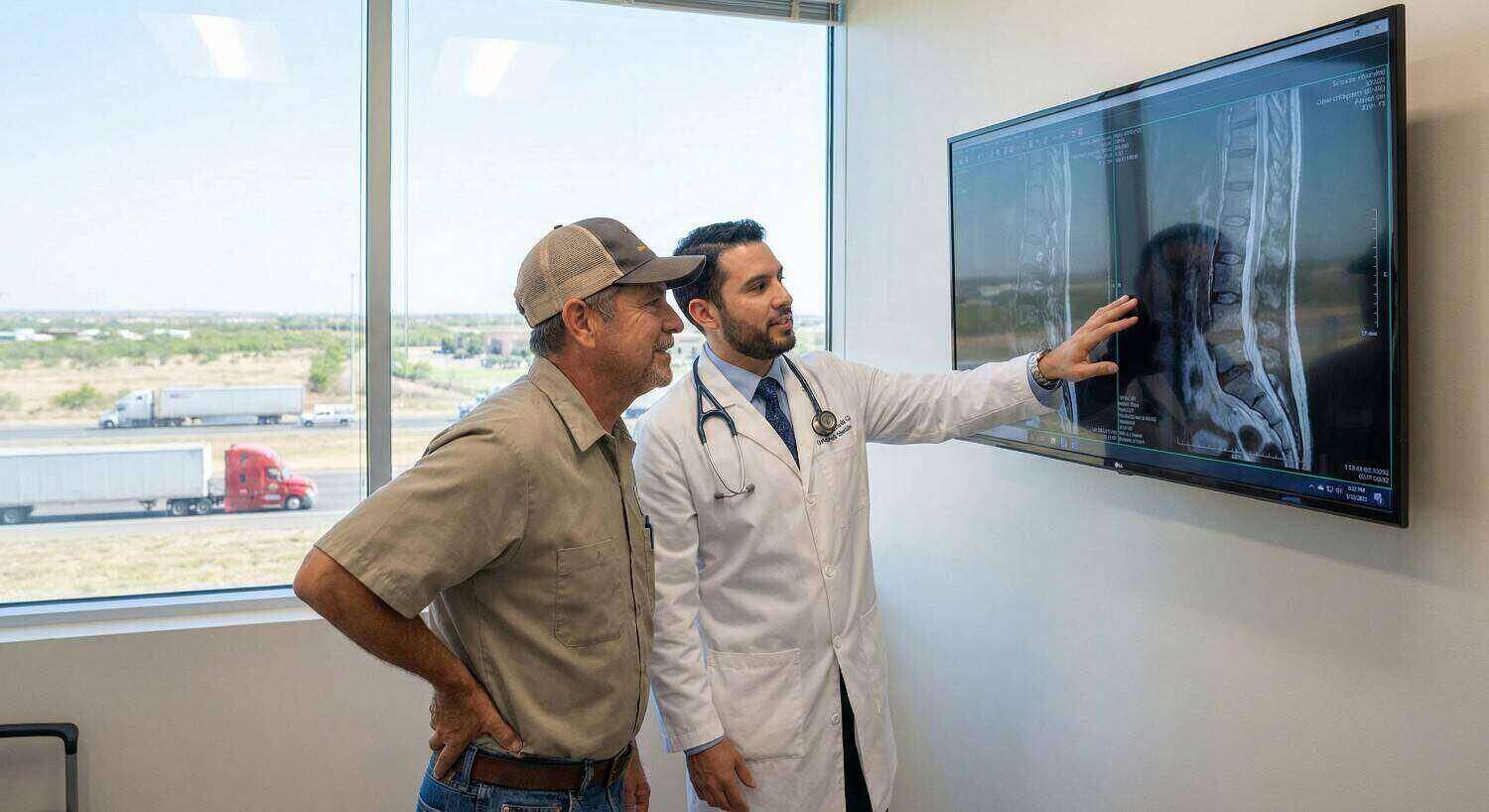
Our physicians use a thorough clinical evaluation — and imaging when necessary — to identify your specific cause before recommending any treatment.
Symptoms: Do These Sound Familiar?
Sciatica is not ordinary back pain. It has a distinct pattern. It travels.
Common symptoms include:
- Sharp, burning, or electric-shock pain starting in the lower back
- Pain radiating through the buttock and down the back of one leg
- Numbness or tingling reaching into the calf or foot
- Leg muscle weakness or a heavy, dragging sensation
- Pain that spikes after sitting, coughing, or sneezing
- Morning stiffness that makes it hard to stand upright
One-sided sciatica is typical. Bilateral sciatica — pain shooting down both legs simultaneously — is a red flag. If you also notice any change in bladder or bowel control, go to the emergency room immediately. This can indicate cauda equina syndrome, which causes permanent nerve damage if not treated without delay.
For all other presentations: if your symptoms have persisted beyond two to four weeks, you need to be seen now, not later.
Still pushing through shooting leg pain every day? Don't wait until surgery becomes your only option. [DEVELOPER: Make this a tap-to-call link on mobile] 📞 CALL NOW: (XXX) XXX-XXXX Our [INSERT: Board-Certified] Laredo spine specialists have same-week openings.
"I drive a rig 11 hours a day and the shooting pain in my leg got so bad I almost lost my CDL. The doctors at Pain Management Laredo had me back in the cab in a month without surgery. Don't wait." — [Patient Name / Initial], Laredo, TX
Your Treatment Plan: A Logical, Escalation-Based Approach
At Pain Management Laredo, we never make you suffer through one step before you are allowed relief from another. Our treatment escalates based on what you need — not on an arbitrary checklist. Here is the full roadmap.
Phase 1 — Immediate Pain Control & Active Rehabilitation
Who it is for: Nearly every patient, beginning on day one.
We do not expect you to push through agonizing pain while doing physical therapy. That is not how medicine works, and it is not how we work.
From the very first appointment, we address pain control and rehabilitation simultaneously. Targeted medications — NSAIDs, muscle relaxants, or a short course of oral corticosteroids depending on your presentation — bring your pain down to a manageable level right away. At the same time, our physical therapists begin the essential work of decompressing the nerve and rebuilding the structural support around your spine.
Pain control on day one includes:
- NSAIDs (ibuprofen, naproxen) to reduce nerve inflammation
- Muscle relaxants for patients with significant spasm
- Short-course oral corticosteroids for rapid inflammation control
- Vitamin B12 and D supplementation when bloodwork shows deficiency
Active rehabilitation runs concurrently and focuses on:
- Core stabilization to reduce load on the lumbar discs
- The McKenzie Method — spinal extension movements with strong clinical evidence for disc-related sciatica
- Piriformis and hip stretches to release muscular compression on the nerve
- Postural correction tailored to your specific work demands
Research cited by the Mayo Clinic confirms that patients who complete a structured physical therapy program recover faster and have significantly lower recurrence rates than those who rely on rest and medication alone. Combining both from the start gets you to relief faster.
Expected timeline: Most patients feel meaningful improvement within 4 to 6 weeks.
Phase 2 — Epidural Steroid Injections
Who it is for: Patients whose pain remains severe after Phase 1, preventing full engagement in rehabilitation.
When inflammation around the nerve root is too intense for medication alone to control, an epidural steroid injection steps in. The NIH recognizes this as an effective short-term intervention for sciatica in appropriately selected patients. At Pain Management Laredo, injections are used precisely and purposefully — never as a routine step, always as a clinical decision.
Here is what a targeted injection does:
- Delivers anti-inflammatory medicine directly to the affected nerve root — where oral medication often cannot reach effectively
- Provides rapid relief, typically within 48 to 72 hours
- Creates a meaningful pain-free window so you can fully commit to physical therapy and make lasting structural progress
This is a tool, not a finish line. The goal is always to get you back into active movement and rehabilitation.
Phase 3 — Minimally Invasive Spine Surgery
Who it is for: A small minority of patients who have not responded to three to six months of conservative care, or those developing progressive neurological symptoms.
Surgery is never our first recommendation. When it is the right answer, we pursue minimally invasive procedures — small incisions, specialized instruments, real-time imaging — that dramatically reduce recovery time and surgical risk compared to traditional open spine surgery.
Microdiscectomy — The herniated disc material pressing on the nerve root is removed through a tiny incision. This is the gold-standard surgical treatment for disc-related sciatica. The American Academy of Orthopaedic Surgeons reports success rates consistently above 85%.
Minimally invasive laminectomy — For spinal stenosis patients, a small amount of bone or tissue is removed to widen the spinal canal and relieve nerve pressure.
What recovery actually looks like:
- Back on your feet within 24 hours
- Light daily activity resumed in 2 to 4 weeks
- Return to physically demanding work within 8 to 12 weeks
All procedures carry risk — infection, bleeding, anesthesia complications. Minimally invasive surgery carries substantially lower risk than open surgery. Your surgeon at Pain Management Laredo will walk through every risk and benefit with you in detail, in plain language, before any decision is made. We do not rush this conversation.
Ready to find out which phase is right for you? Our Laredo spine team is taking new patients now — and we move fast. [DEVELOPER: tap-to-call link] 📞 CALL: (XXX) XXX-XXXX Or book online at painmanagementlaredo.com
How to Keep Sciatica from Coming Back
Getting relief is the immediate goal. Staying out of pain is the real one. After treatment, your long-term plan should address the conditions that allowed sciatica to develop in the first place.
- Daily core strengthening — A strong core distributes spinal load more effectively and shields your discs from cumulative stress
- Posture and ergonomics — Proper lumbar support, structured movement breaks, and correct positioning for your specific work environment
- Weight management — Every additional pound of body weight increases compressive force on your lumbar discs
- Nutritional maintenance — Vitamin B12 and D levels should be monitored and maintained to support ongoing nerve health
- Consistent movement — Staying sedentary is one of the fastest ways to invite sciatica back
Patients who pair successful treatment with these habits have a significantly lower recurrence rate. At Pain Management Laredo, we build your prevention plan alongside your immediate care — because the goal is not just relief. It is resilience.
Start Your Recovery Today
You have already spent enough time in pain.
Whether your sciatica started after a long haul on I-35 or built up slowly over years of demanding work, Pain Management Laredo has [INSERT: board-certified, fellowship-trained] specialists ready to diagnose it accurately and treat it effectively — from Phase 1 immediate pain control all the way through minimally invasive spine surgery if that is what your case requires.
The next four weeks are going to pass anyway. You can spend them in pain, or you can spend them recovering. Make the call.
Pain Management Laredo | Laredo, TX | Serving Webb County and South Texas
Frequently Asked Questions
Q: What is the most successful treatment for sciatica? For most patients, the combination of targeted pain control and structured physical therapy — delivered simultaneously from day one — produces the best outcomes without surgery. The AAOS reports that over 80% of disc-related sciatica cases resolve fully with conservative care. Consistency is the deciding factor. A good plan followed halfway will not deliver full results.
Q: Is sciatica 100% curable? For the majority of patients, yes. Roughly 80 to 90% recover fully without surgery. A small percentage require a minimally invasive procedure to achieve lasting relief. After recovery, maintaining core strength, healthy body weight, and good postural habits significantly lowers the risk of recurrence.
Q: What is the best exercise for sciatica? There is no universal miracle move. The McKenzie Method has the strongest clinical evidence for disc-related sciatica. The piriformis stretch, knee-to-chest stretch, and bird-dog are also consistently effective. The right exercises depend entirely on what is causing your sciatica — which is why your program should be designed by a physical therapist, not found on social media.
Q: What vitamin deficiency worsens sciatica? Low vitamin B12 and vitamin D are both linked to increased nerve pain and slower nerve recovery. B12 is essential for the myelin sheath that protects nerve fibers. Vitamin D plays a direct role in inflammation regulation. Both deficiencies are easy to identify with a blood test and straightforward to correct. We check for this at your first visit.
Q: Is bilateral sciatica dangerous? Yes. Pain radiating down both legs simultaneously is uncommon and requires urgent evaluation. It can indicate cauda equina syndrome — compression of multiple nerve roots — which causes permanent neurological damage if not treated quickly. If you experience this alongside any bladder or bowel changes, go to the emergency room. Do not wait for a scheduled appointment.
Q: How long does recovery from minimally invasive sciatica surgery take? Most patients are mobile within 24 hours of surgery. Light daily activity resumes in two to four weeks. Return to physically demanding work typically takes eight to twelve weeks. Your specific timeline depends on your age, overall health, and how closely you follow your post-surgical rehabilitation plan.
Q: How do I get an appointment at Pain Management Laredo? We are centrally located in Laredo, making top-tier spine care accessible to patients across Webb County without the drive to San Antonio. Same-week appointments are frequently available. Call our office directly — we will get you in as fast as possible.